

by Prof. (Dr.) Sadhan Chandra Ray
Former Professor of DJFT, University of Calcutta
Council Member and Member of CATE & TXDB of IEI
Introduction
Knitting is the second most popular technique of fabric or garment formation by inter looping from one or one set of yarn either by hand or by machine. Knitting is comparatively simpler and faster technique formation of fabric or garment suitable for almost all purposes including technical textiles. On account of manufacturing flexibility and diversity, knitting technology has been advancing at a very speed with the help electronic sensors and computers. Weaving, the technology of producing fabric by interlacing two sets of threads (warp & weft) is the oldest (7000 years) technique of fabric formation with a market share of 65%. Knitting is the second oldest (3300 years) technology of fabric formation and its share in fabric production is about 25 %.
Till the middle of 20th century, knitting was weft knitting only whether hand knitting or machine knitting. Warp knitting, more versatile than weft knitting, entered the market around 1946. Power driven knitting machines – both weft and warp – run at much lower speed than weaving looms, but rate of fabric production is much higher than weaving. As kitted fabric is made using only one or one set of yarn, there is no warp and weft yarns in the fabric. So, classification of weft and warp knitting is done based on direction of movement of yarn with respect to the direction of fabric formation. Knitting started with woolen yarn, and subsequently cotton became the major fibre for knitting, Presently, not only the natural fibres, the newly developed man-made fibres are equally preferred and used in knitting. In general, the knitted fabrics are stretchable, and can take the shape of the contour of the human body and hence very much popular for inner garments.
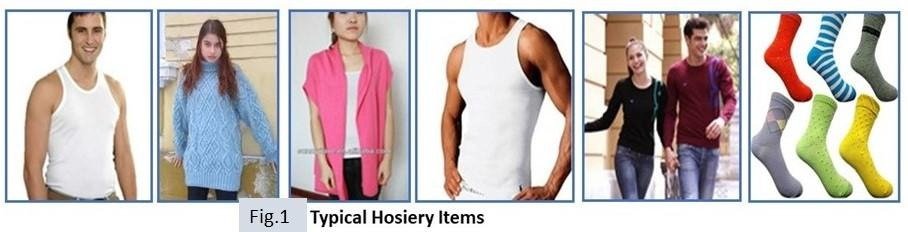
The traditional products are shown in Fig. 1.
Science Aspects of Knitting:
In the beginning knitting was basically an art of fabric manufacture, with the passing of time the technology and engineering aspects of knitting developed. The science aspects of knitting were there but hidden. Science aspects of knitting started unveiling only about seventy years back. With the development of applied sciences in other branches of study, particularly Electronics and Computer, the knitting technology has flourished like anything. CAD & CAM along with online process control are now the basic tools in designing and engineering of any product keeping in view the requirements of the consumers. The benefits of studying knitting science started implementing in 1970s, when developments of electronics and computer as well as their applications in industry had just resulted the 3rd industrial revolution (Industry 3.0). As a result of well blending of science, engineering and technology, a lot of innovative works were undertaken in the field of knitting dealing with better quality knitted products. The most important parameter of a knitted fabric is loop length which can be varied during knitting by changing machine parameters, process parameters and yarn parameters. The other important parameters of a knitted fabric which are considered for assessing the quality of the fabric are courses per inch, wales per inch, stitch density, GSM and tightness factor.
IoT in Knitting
The Fourth Industrial Revolution (or Industry 4.0) is the ongoing transformation of traditional manufacturing and industrial practices combined with the latest smart technology. This primarily focuses on the use of large-scale machine to machine communication (M2M) and Internet of Things (IoT) deployments to provide increased automation, improved communication and self-monitoring, as well as smart machines that can analyse and diagnose issues without the need for human intervention. In the meantime, Robotics based intelligent machines have been engineered for knitting and knitwear industries that can help and assist humans in their day-to-day lives and keep everyone safe. Robotics machines can also substitute for humans and replicate human action.
Seamless Garments/Products:
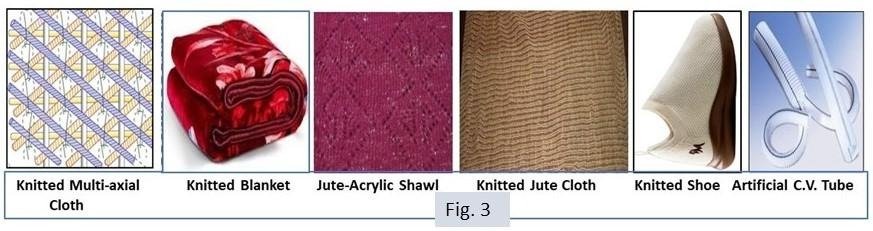
The combination of latest machineries and innovative ideas of knitting technologists has made it possible to manufacture fabrics, garments and shaped end products suitable for every application of our livelihood, which are not possible by other techniques of fabrics manufacture. One of such significant developments in knitting is the direct manufacturing of – seamless garment with proper shaping for better comfort. In case of seamless knitting, the traditional techniques of cutting and sewing are avoided. The newly developed knitting machines, whether weft or warp knitting, are no more restricted for producing traditional inner and outer products but are mostly used for manufacturing innovative and speciality products as well as all types of technical textiles starting form geo-textiles to artificial Cardio-Vascular tubes needed in Heart Operation of human being. Some of the innovative knitted products have been shown in Fig. 2 & 3.
Advantages of Knitting
- Knitting is a simplified and short cut technique of fabric production at lower production cost.
- Fabric can be produced from a minimum number of yarns, even may be one.
- Loop size can be varied to a wide extent and that too very easily.
- During knitting loops can be transferred from one needle to another.
- The extensibility and stability of the knitted fabric can be engineered.
- The desired porosity or compactness of the fabric can be achieved easily.
- Shaping can be done at the time of knitting on the resultant fabric.
- Loop structures are easily distorted under tension in application which imparts more freedom of movement and comfort for the wearer.
- Fabric with single face, double face, open-work and surface interest can be knitted according to requirement, and that too at a higher rate of production than weaving.
- The number of yarns to be knitted in the same fabric can be varied.
- Seamless garments can be directly produced during knitting process
- Number of needles for loop formation can be varied during knitting cycle.
- Yarn wastage is negligible during producing fabric by knitting
- Knitting can produce various/diversified technical textiles.
- Multiaxial, Spacer and 3-D fabrics can easily be produced in warp knitting.
- Knitting results better Protection of environment in terms of less power consumption, less noise level and wastage as well as fluffs generation. (lower carbon footprint / eco-friendly).
- Knitting offers better lifestyle of both consumers and producers.
Conclusion
Knitting has been playing an important role for the production of various fabrics and apparels out of both natural and manmade fibres in order to fulfil the diversified requirements of mankind. Knitting will play it’s vital and diversified role for the sustenance of both natural and man-made fibres in future too causing lesser pollution to the environment. From the abovementioned information, it’s confirmed that knitting is eco-friendly and sustainable technique of fabric formation.
Originally published on Tantu Journal 2025
