

by Alak Mazumder
B.SC., B.SC.(TECH), LLB, FIE, CHARTERED ENGINEER, LIFE MEMBER(AIMA)
Introduction
Textiles are essential to humans in a variety of ways, especially clothing. However, the speed at which they end up in landfills is astonishing (one garbage truck per second), posing a severe risk to the environment, if the trend continues. Sustainability and recycling in the textile and apparel industry are crucial for reducing environmental impact and promoting a circular economy.
Governments and responsible organizations are starting to make calls to different stakeholders to redesign the textile chain from linear to circular economy. In this perspective, we highlight some of the possible approaches to be undertaken including the need for the creation of renewable raw materials sources, rethinking production, maximum use and reuse of textile products, reproduction, and recycling strategies, redistribution of textiles to new and parallel markets, and improvising means to extend the textiles lifetime.
Some Facts
Global clothing consumption is 400% more than the amount consumed two decades earlier (Jiaet al. 2020; Shirvanmoghaddam et al. 2020).
The growth in consumption dictates the amount of energy utilized in running production, the number of materials in circulation, and handling means of the materials during usage, which all seem detrimental to the environment (Chae and Hinestroza 2020; Sadeghi et al. 2021).
Textile production is the world’s second most polluting industry, second to the oil industry accounting for approximately 1.2 billion tons of greenhouse gas emissions (more than for international flights and maritime shipping combined) (Change 2018). By 2050, it is anticipated that the fashion industry will use up to 25% of the world’s carbon budget (Pandey 2018). There is an urgent need to tackle the adverse effects of the fashion industry for sustainability through circular economy approaches (Saha et al. 2021).
Perspective
We highlight some of the approaches the textile and apparel industry can adopt to overcome the challenges it is facing, for its survival in the new, strict, and upcoming green circular economy which requires maximum use of resources with little or no waste, with zero emissions, but still able to make profits without harming the environment.
First, we briefly reveal the state and wastefulness of the textile and clothing industry by describing the following: the effect of fast fashion, fiber production, and water consumption together with pollution.
Second, we explore how the current linear economy of the textile and clothing industry can be changed to a circular economy by individually focusing on raw materials, products, products, use, and after-use activities.
Finally, a summary of the key issues containing a conclusion and detailed outlook is provided in this article.
State of the clothing and textile industry
The current state of the fashion, clothing, and textile industry is worrying in the space of sustainability.
As we stand on the precipice of a new era in fashion, one that prioritizes sustainability and environmental consciousness, it’s crucial to consider the role of textile recycling in this evolution. The questions that we can ask ourselves are:
How can we mitigate the environmental impact of textile waste, a byproduct of our fast-fashion culture?
How can we harness the power of textile recycling to not only reduce waste but also create a more sustainable fashion industry?
Are we ready to weave a new narrative in fashion, one that values sustainability as much as style? Let’s embark on this journey together, exploring the transformative power of textile recycling.
As a part of comprehensive exploration to find the answers, we delve into the innovative techniques that are revolutionizing textile recycling, transforming it from a niche concept into a mainstream practice.
Understanding the Impact of Textile Waste on the Environment
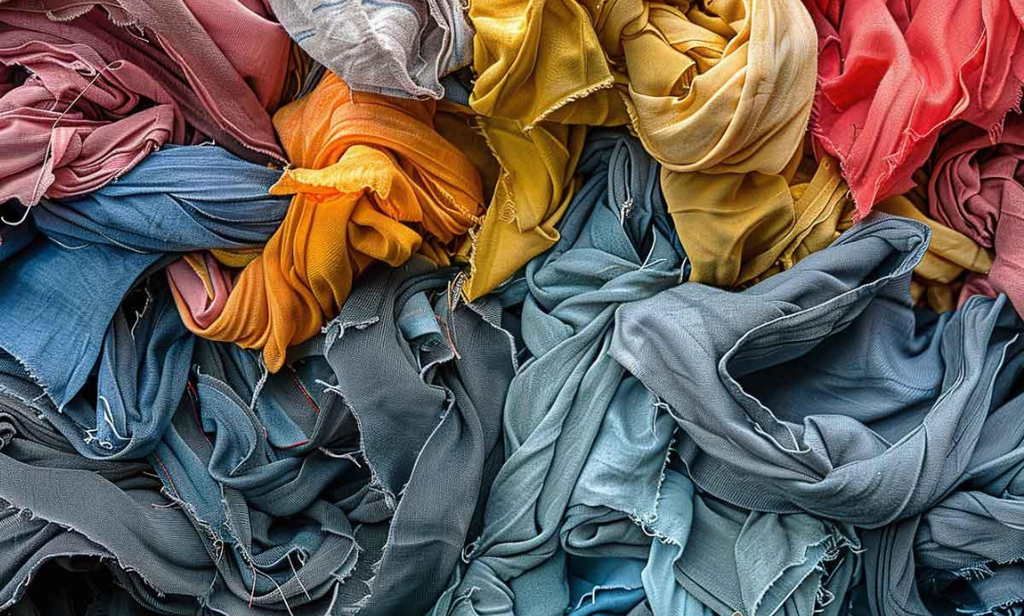
The fashion industry is a significant contributor to environmental degradation, with textile waste being a major concern. The production, consumption, and disposal of textiles have a profound impact on our planet. Textile waste contributes to landfills, releases harmful chemicals, and consumes vast amounts of water and energy. It’s estimated that nearly 20% of global wastewater is produced by the fashion industry, largely due to dyeing and treatment processes. Furthermore, synthetic fibers, which are non-biodegradable, can take up to 200 years to decompose.
a) Fast Fashion
Fast fashion accelerates the number of clothing purchased globally given the fact it happens when the demand is high and at low prices.
- Statistically, an average American generates 82 lb of textile waste each year, and the USA alone dumped (landfills or burned) close to 14 million tons of textile waste in 2018 with only 2.5 million tonnes recycled (EPA 2021).
- Globally, 92 million tons of textile waste is generated per year with 134 million tons per year expected by the end of 2030 (Kerr and Landry 2017). These contents of fast fashion such as high production, low quality, and competitive pricing pose a negative impact on the environment, resources and people involved (both in production and consumption). Therefore, there is need to control fast fashion, towards non wasteful and green economy (Moorhouse and Moorhouse 2017).
b) Fiber Production
Global fiber production reached 111 million metric tons in 2019, which has doubled in the last 20 years (Shirvanimoghaddam et al. 2020), with pre-COVID-19 results indicating potential growth to 146 million metric tons by 2030 (Worley 2020). Fibers used in clothing can be subdivided into two major categories; natural and synthetic fibers.
Fiber production nowadays is dominated by synthetic fibers (~ 69%) with the rest shared between natural fibers and blends of natural and synthetic fibers. It is estimated that around 98% of all future fibers will be synthetic, 95% of which is expected to be polyester (Qin 2014).
The rise in synthetics poses an environmental concern due to many reasons in various perspectives (Young 2019).
- The production of synthetic polymers is estimated to utilize 98 million tons of oil globally each year which can be used directly as fibers, dyes, and finishes hence dependent on fossil fuel extraction (Morlet et al. 2017).
- Synthetic fibers are non- biodegradable. They can stay in the environment for many years.
- Also, given that fibers are small (micron size), they are more detrimental than centimeter-scale plastics. For example, washing synthetic clothing tends to nano and microfibers into waterways causing immeasurable damage to marine life and vital ecosystem and cannot easily be traced (Young 2019).
- The energy used and the resultant CO2 emission as a result of obtaining synthetic fibers is much higher as compared to natural fibers (OEcotextiles 2011).
c) Water Consumption and Pollution
The clothing cycle (production to usage) is currently wasteful and polluting. Fiber production, clothing production, use, and after use all consume an enormous amount of water and leaves traces of fibers and chemicals in water sources.
More still, the textile industry is estimated to be responsible for 20% of global water pollution as a result of dyeing and finishing during production (Kant 2012). Moreover, fiber production and clothing production usually take place in developing countries. Later manufactured clothes are transported to developed countries. The logistics alone are not sustainable.
The products (clothing) produced with such wasteful approaches are only used for a limited time, and not recycled but dumped/landfilled in the environment.
Solution
Let us now discuss the different ways to mitigate these problems.
1. Circular Economy
The current clothing system in regard to manufacturing, distribution, and usage of clothing operates in an almost entirely linear way.
Over 7 3% of current fibers are extracted from non-renewable resources such as fossil fuels to make clothes (with polluting processes) which are used for a very short time, which later are dumped in land- fills or incinerated.
Over $183 million worth of clothing goes into landfills each year (Wrap 2020). Such a linear system leaves many economic opportunities untapped, pollutes and degrades the environment, exerts pressure on scarce resources, and strains the economies of societies.
The circular economy is briefly driven by 3 major activities and approaches (Fig. 2) i.e. reduce, reuse, and recycle, which are all typical approaches of traditional waste management (Manickam and Duraisamy 2019).
- Reduction broadly involves waste reduction at all the steps of production (including minimal raw materials usage) and different stages of consumption and use.
- Reuse in this space entails rethinking production to obtain products that can be easily recycled or repurposed for a variety of other applications. Ultimately, increased reuse and repurposing will mitigate the increased need for production.
The economic value of the circular economy is obvious, and in terms of monetary value, it is estimated that the world economy could be improved by $192 billion by 2030 if the fashion industry addresses the problems presented by its current linear economy (Morlet et al. 2017).
Some of the critical activities facilitating circular economy include: creating renewable sources, rethinking production, maximum use and reuse, reproduction, and recycling, redistribution to new and parallel markets, extending product lifetime, and many others (Kumar and Saravanan 2019).
2. Recycling Clothing
Getting fibers back to the circular loop:- Fibers make almost 98% of finished clothing. 73% of fibers used in clothing ends up either in landfill or an incinerator with only 12% recycled (Morlet et al. 2017). Fibers are small and are exposed to rough processes during recycling which damages their quality, and thus only 1% of the recycled fibers can be utilized again in clothing. However, as a solution, new fibers can be readily blended with old, recycled fibers to strike the right balance between quality and sustainability.
With the growing awareness of the environmental impact of the fashion industry, innovative techniques in textile recycling are becoming increasingly important. These techniques are not only redefining the way we approach waste management, but also paving the way for a more sustainable future. One such technique is the use of chemical recycling, which breaks down textiles into their chemical building blocks and later melt-spun into new fibers with exactly similar properties as the new virgin fibers entering the circular loop.
Another promising technique is mechanical recycling, which involves shredding textiles and spinning them into new yarn. These methods, while still in their infancy, hold the potential to drastically reduce the fashion industry’s environmental footprint, and represent a significant step towards a more sustainable future.
In the case of synthetics, such as polyester, the fibers can be chemically broken down to their chemical building blocks and later melt-spun into new fibers with exactly similar properties as the new virgin fibers entering the circular loop.
This strategy has two main challenges: (1) Sorting and (2) economics.
On the economics, chemical fiber recycling has proven to be expensive, resulting in fibers that are far more expensive than considering new virgin fibers.
Blending in textiles can happen at the fiber level, yarn level, and fabric level. These different levels pose the recycling department with new strategies to effect sorting before recycling. Overall, it is simplistic to state that clothes are easy to recycle.
3. Sorting As One of The Key Challenges
a) Radio Frequency Identification (RFID):
RFID tags can be employed to sort clothes at a fabric level. They are added to fabric hems during garment production and are capable of remaining active during the whole process of clothing use. Beyond sorting capabilities, with RFID tags, the manufacturer can track the clothing within and out of the store and are sources of big data to the manufacturer to monitor product use and later collection after use.
B) Solvent Technologies:
At the fiber and yarn level, RFID tags cannot be employed to sort materials, but solvent technologies can be readily employed.
Solvent technologies can be subdivided into two as follows:
- Dissolving the soluble and remaining with the insoluble. For example, cotton/polyester fibers in fabrics can be sorted by dissolving cotton cellulose in a solvent and then leaving polyester behind. The cellulose dissolved can be used to make new synthetic fibers with natural recycled sources as in the case of Lyocell, Rayon, Cupro, and Acetate fibers. Also, if the quality is not great, it can be used to make pulp and paper. These approaches are sustainable and the back- bone of the circular economy.
- High- temperature heating which dissolves one fiber and leaves the other fiber behind as solid. This approach depends on the melting temperature difference (higher difference) of the fibers to be sorted. Scaling up these technologies is still a challenge but are key solutions to avoiding a linear clothing economy.
C) Bio sorting:
This concept attempts to utilize living organisms or enzymes to consume part of the fibers and leaving behind the other. Beyond bio sorting, bio recycling is possible in which the enzymes depolymerize textile waste fibers into their original monomers (Burik 2018). In this approach, sorting can be bypassed, decreasing the overall costs.
4. Reuse And Repurpose of Clothing
Reusing and repurposing clothes are essential activities in facilitating a circular economy. Some countries (such as Germany) have high collection rates of textiles for reuse to a tune of 75% of textiles (Morlet et al. 2017) which are usually exported to low-developing countries for extended use. However, in the countries where second-hand clothes are exported, similar collection infrastructures do not exist and thus used clothes will end up in landfills (Watson et al. 2016). One of the solutions is to repurpose the clothing to new uses.
5. Resale And Rental Approach
Through the resale and rental approach clothing use can be extended, which can slash the environmental impact of clothing. The success rate is relatively high with the resale and rental program capable of adding some dollars to the customers’ pockets.
Conclusions And Outlook
The new clothing and textile circular economy
The ambitions of the new circular economy aim at re-inventing and bending the linear economy to more sustainable approaches. This can be focused on four major parts of the clothing system wheel as follows:
(1) materials, (2) production, (3) usage, and (4) after usage.
In all sections, enormous innovation which is paramount, can take place in the form of (1) phasing out of substances of concern and microfiber release, (2) increasing clothing utilization, (3) improving recycling and (4) making effective use of resources and migration to renewable inputs.
In the different stages, the following can be done.
- Materials:
The raw materials for textiles should be made renewable, or easily recyclable with little or no concerns to the environment. Concerns about the small, untraceable fiber plastics can be solved by using biodegradable fibers.
- Production:
- Renewable energy should be used to run production machinery which should also be designed to be energy-efficient.
- Intensive energy processes requiring high volumes of water with high pollution such as wet processing during dyeing can be replaced with printing and use of naturally derived dyes or low-temperature synthetic dyes in single big batch dyeing processes.
- Also, care should be taken to treat the effluents before disposal and never in the natural water stream.
- Usage:
This is aimed at increasing clothes usage with less environment.
- Short term usage can be controlled by resale and rental approaches.
- Fast fashion can be discouraged to target durable clothing with higher quality enabling long term use through brand commitment and policy.
- Modern designs with anti-soiling effects can be promoted, which need less washing, hence saving water, greenhouse gases emissions and fibres /dyes coming from the cleaning process to the water stream.
- After usage:
It incorporates technologies such as RFID to facilitate the collection, sorting, recycling and reprocessing. Rethink recycling technologies to make them cheaper and affordable.
Originally published on Tantu Journal 2025
