

Sayoni Nath1, Anirban Dutta2
1Final year Master of Fashion Technology, National Institute of Fashion Technology, New Delhi-110016, Indi
2Assistant Professor, Government College of Engineering and Textile Technology Serampore, West-Bengal-712201, India
Abstract
Reuse is one of the most significant components of modern waste reduction tools. More specifically, reuse is the second entity of the ‘Reduce, Reuse and Recycle’ hierarchy. It is evident that reuse of old and abandoned apparel goods is one of the major tools, so far as the sustainability and conservation of natural resources are concerned. As, a huge quantity of water and other natural resources are consumed for manufacturing of dyed or printed textile fabrics, therefore, multiple and recurring usage of the same textile fabrics for different consumable goods are essential for global sustainability. In this context, an approach has been made to reuse the old and abandoned saree for making fashionable home furnishing items like doormats, window curtains etc. In this present case an old saree is used to create fashionable doormats. Several layers of the saree fabric are stitched together to generate the necessary areal density required for doormat. Also, surface embroidery is done to add sufficient stability, surface friction, and aesthetic value.
In the back side of the doormat, braided structures developed from the same saree are stitched together to enhance the stability and dust-absorption capacity. The consumer acceptability of that doormat and consumer response are analysed through online market survey. Also detailed cost analysis has been made. It is found that a number of fashionable, consumer-friendly and cost-effective doormats can be prepared from one single old saree. Based upon the consumers feedback obtained through market survey, the developed product is found to be very effective in the context of both holistic fashion-value and sustainability. Also, it is found that the carbon footprint, energy and water consumptions are much less in this case compared to those in case of preparation of such fashionable home furnishings using fresh fabrics.
KEYWORDS: Zero waste , Circular Fashion , Sustainability , Reuse , Doormat , Holistic fashion
Fundamental Significance of This Project
Fashion and apparel industry is largely considered as the second most destructive industry, in terms of both consumption of natural resources and addition in pollution level to the environment. A European Union initiative called ‘European clothing action plan’ has been launched to significantly improve the sustainability of textile and fashion industry across their life cycle from design to end-use by 2019 (Mummery I., 2017). In this context, zero waste fashion refers to the items of clothing that generates a little or no textile waste in their production. It can be considered as a broader aspect of sustainable fashion movement. Zero waste fashion is generally divided into two general approaches – pre consumer zero waste and post-consumer zero waste. Pre consumer zero waste fashion eliminates the waste during manufacture. Whereas, post-consumer zero waste generates clothing from consumed waste (The New York Times, 2014, Wikipedia, 2021).
Zero waste fashion and circular fashion are related with each other. Circular fashion is a system where our clothing and personal belongings are produced through a more considered model: where the production of an item and end of it’s life both are equally important (Hill M., 2020). The circular concept is what slow fashion is all about and offers real hope for the future of the industry and the planet. It involves designing fashion with longevity, repair and recycling (Wikipedia, 2021, Moorhouse Debbie and Moorhouse Danielle, 2017). Sustainable and ethical fashion is an approach towards sourcing, manufacturing and designing clothes which maximizes the benefits to the fashion industry and the society at large. While at the same time, minimizes it’s impact on the environment. The two concepts are overlapped in ideology but each have slightly different concerns, both are equally critical and significant to the future of fashion (Mummery I., 2017, Hill M., 2020, Moorhouse Debbie and Moorhouse Danielle, 2017). The sustainable design approaches in relation to zero waste fashion and the implementation of circular economy approaches by reuse or recycle for the overall reduction in the consumption of the energy and water are essential for the sustainability of environment.
In this context, the most significant fact is that a huge amount of water and natural energy is consumed in producing fabric. For example, it is evident that the approximate total amount of water, thermal energy and electrical energy generally consumed for the manufacture of one dyed saree are 5.56 litre, 23,098.5 Kcal and 2.30 KWH respectively (Higgins L. 2018, OEcoTextiles , 2009). It is therefore obvious that the prime objective of sustainable and holistic fashion design must be to create a longer life cycle of fabric by multipurpose and cyclic usage through reuse, without compromising in the fashion value.
In this present research, main objective has been to implement the principle of circular economy in apparel, by reusing and converting the old apparel goods into fashionable and presentable home furnishing items for further usage in different purpose, so that the life cycle of the base fabric can be extended. The bottom-line of this work is to spread awareness about the need of reuse and circular economy, so far as the sustainability of the planet earth is concerned.
Project Findings in Brief
The outcome of the present project is a very encouraging example of the reuse of old wearable apparels for manufacturing of a new home-furnishing item with entirely different domain of end-use. Fashionable doormat is produced from one single saree. Application of surface embroidery is found to be effective to enhance the aesthetic value, by suppressing the surface dullness of the old saree. Addition of braided structures (made from the same old saree) are very useful to enhance the stability and dust absorption capacity of the doormat (Fig. 1 to 3).
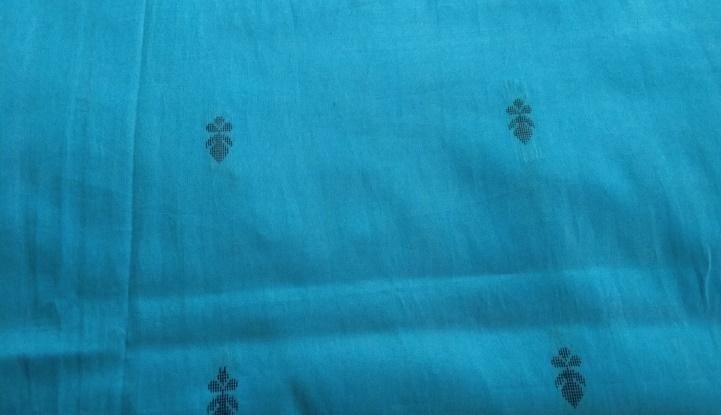
Fig.2: Embroidered front surface of the doormat
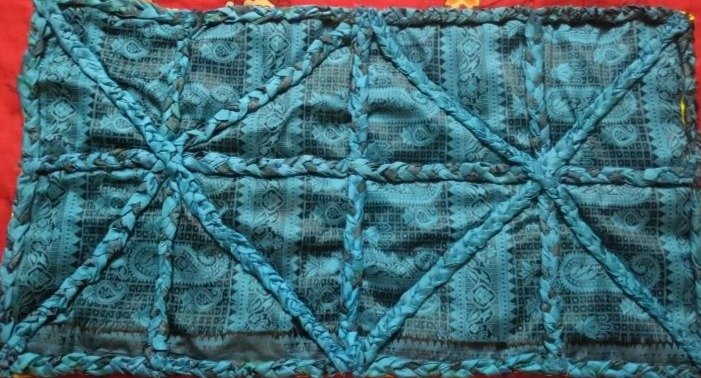
Fig.3: Braided Back part of the doormat
Moreover, it is found to be very cost effective, as it is evident that a number of fashionable, consumer-friendly and cost-effective doormats can be prepared from one single old saree, depending upon the size of the doormat. Also, only the cost of embroidery threads and sewing threads are there as additional material cost, in addition to the labour cost for embroidery and stitching. Based upon the consumer responses as obtained through market survey, it is found that the manufactured product is widely accepted so far as its fashion value and market acceptance are concerned. In addition to that, it is very inspiring to note that most of the consumers are well aware and they highly recommend the need of circular economy in fashion through such holistic approaches. On the other hand, it is very significant to mention here that, the carbon footprint, energy and water consumptions are much less in this process, compared to those in case of preparation of such fashionable home furnishings using fresh fabrics.
Mandatory Disclosure: The Extended version of this paper is presented at the 35th National Convention of Textile Engineers and National Seminar on Resource Efficient Technologies in Textile Manufacturing , Organized by the Institution of Engineers (India), Textile Engineering Division Board, jointly with DJFT University of Calcutta, in collaboration with Lohia Corp Limited and The Textile Association (India) (West Bengal Unit), 11th-12th March 2023, Page number in the book of proceedings: 182-187
References
- Higgins Leah, (2018) ,’ How much water?’,‘Cloth in Common’ , 6th Nov 2018 available at https://clothincommon.com/how-much-water-d45/
- Ismay Mummery , (2017) , ‘Zero Waste and Circular Fashion Sustainable Fashion’ , Sept 2,2017 , available at https://boywonderland.com/zero-waste-circular-fashion/
- Madeleine Hill,(2020),‘What is Circular Fashion’, 6th Jul, 2020,
Available at https://goodonyou.eco/what-is-circular-fashion/
- Moorhouse Debbie and Moorhouse Danielle , (2017), ‘Sustainable Design: Circular Economy in Fashion and Textile] , ‘The Design Journal’, Vol.20 , Issue Sup1, July 2017. Available at : https://doi.org/10.1080/14606925.2017.1352713
- OEcoTextiles, (2009), ‘What is energy profile on textile industry, June 16,2009 , available at : https://oecotextiles.blog/2009/06/16/what-is-the-energy-profile-of-the-textile-industry/
- The New York Times , (2014), www. nytimes.com
- Wikipedia (2021), ‘Zero Waste Fashion’ , available at https://en.wikipedia.org/wiki/Zero-waste_fashion
